

The Rusticators
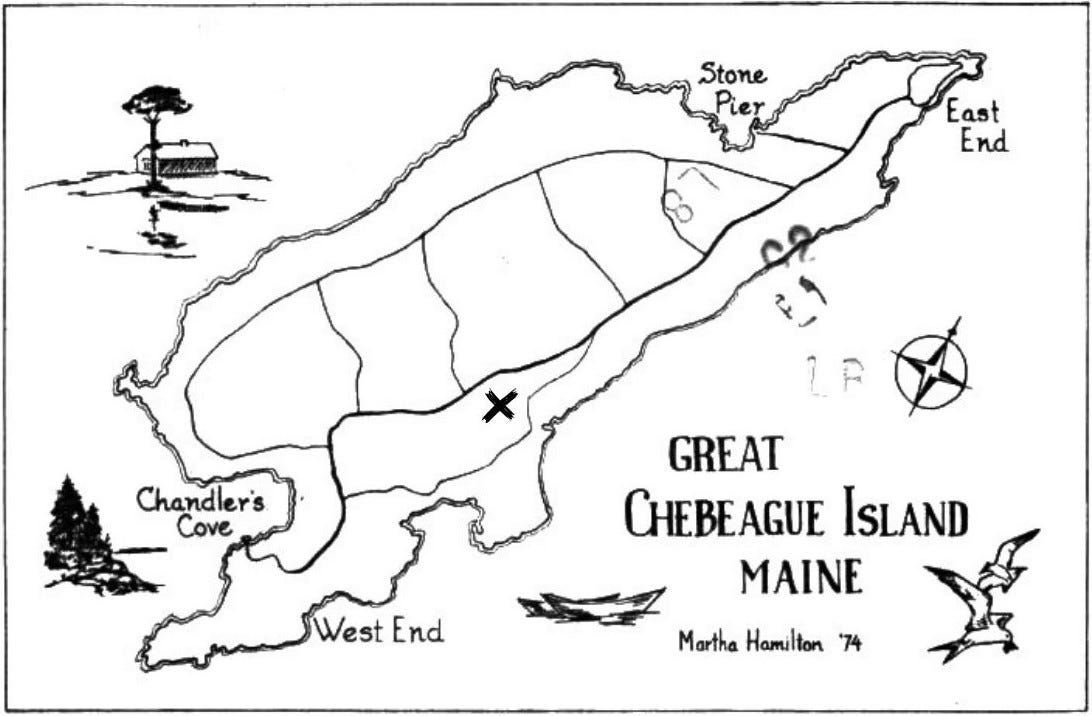
In April 1905, Ammi Littlefield sold a cottage lot on Chebeague Island to Nellie M. Heart (of Newton, MA). Ammi was one of the Littlefields’ sons. The Littlefields had probably the largest farm on Chebeague; it included what is now the boatyard and all the surrounding area. Members of the family were pursuing other vocations (stone slooping, etc.), so the Littlefields started selling off half-acre cottage lots in the area that is now known as the Massachusetts Colony. This was around the time Casco Bay became a location of interest for the rusticators.
My earliest memory of Chebeague Island is the itch of poison ivy. I believe I was around four years old; it was the summer and my family had gone to The Hook, a peninsula on the west side of the island that seems to curl in on itself. It’s a popular beach because it has a sandbar, and when the tide is low enough, one can use this sandbar as a bridge that connects mainland Chebeague to the aptly named Little Chebeague. It is on Little Chebeague where I, in my childlike reverie, stepped on the poison ivy that would form my first Chebeague memory.
My family owns a small cottage on Chebeague. Chebeague Island is one of many off the coast of Maine in Casco Bay. My dad inherited the cottage from his parents; his family has owned the land for generations.
My dad is the type to never talk about himself beyond immediate subjects, actions, and events of interest—because those he will detail for you gladly, without any request to do so at all. If he went fishing, if he is working on a project, if he sailed that weekend, you will be sure to know the next time he sees you; or, as he does often, he will interrupt the current conversation to discuss his imminent pursuits, perhaps a few days in advance, so excited about the near future to where he has no choice but to blurt out his plans, like a giddy, overzealous prophet. I have always found it endearing. But often these reveals are premature, because he will just as readily abandon, delay, and divert plans on a whim. My dad suffers from the attention span of an amnesiac. An example of this tendency that still amazes me comes from my mom, where, a month into their relationship, after so many detours and delays, she realized that to so much as be in the presence of my dad she needed to pack a day bag fit with items for survival; and this attitude came to a head when, on the day the engagement ring my dad purchased was ready, while they were running errands, he abandoned my mom to pick it up. She was stranded inside that Walgreens, five minutes away, for two hours.
In 2020, without much to do in a COVID-induced lockdown, my dad became obsessed with the history of Chebeague. He announced his newfound interest one day to my family—no doubt interrupting a conversation of some other, wholly unrelated topic—explaining how he had happened upon an online archive of old Chebeague newspapers detailing the history of the island and the deed for our little cottage. In that moment, after long being accustomed to his selective reticence and no longer noticing it, I realized my dad and I had never really talked about his experiences in Chebeague—so I asked, and since then, we have had various conversations covering the years he spent becoming acquainted with Chebeague, the years passed down to him from his family, and the years only reachable through those old newspapers he so dutifully scoured.
Your great-grandfather, James Otey, died of an unfortunate heart attack in his 50s. As a child, he lived for a while and attended school in the Panama Canal district while his father worked on the construction of the canal. After his death, his teacher from Panama, Mrs. Davis, invited Grandma—your great-grandmother—and my mom to her island home for a vacation. It turns out Mrs. Davis was a Chebeague Island rusticator. They immediately fell in love with the island and made an offer to purchase the cottage next door.
“There—that ‘rusticator’ word again. You keep saying it without telling me what it means.”
Oh, Robert, you should know this! Going as far back as the 1800s, the rusticators are the ones who “sojourn” in Maine during the summers in search of a more “rustic” lifestyle.
I paused for a moment. “Does that make us rusticators?”
Yes! he said, a little exasperated as if it were obvious.
I must make a distinction: one is not a rusticator just because they vacation in Maine during the summer months. To be a rusticator is to strive for a rustic ethos, the ideal rustic life. The spirit of one’s travels must align with the requirements outlined in the rusticators’ code. While not written down, rusticators understand this code tacitly, perhaps by way of a sixth sense, intuition, or telepathy. One can only follow the rusticators’ code after having been, in a word, rustificated.
Chebeague is small. Geographically, it takes about ten or fifteen minutes by car to go from end to end. The Census Bureau lists Chebeague as 24.56 square miles. It is the optimal size for a rusticator. There is one bar and one inn, and islanders pick up multiple occupations to compensate for the lack of personnel: your neighbor could be the plumber, the gardener, the electrician, and the musician who plays weekends at the aforementioned only bar.
But getting to Chebeague takes some effort. The rusticators prefer it this way. In being difficult, no matter the physical distance, the process of traveling to Chebeague spiritually distances the rusticators from their journey’s starting point. For my family, the trip to Chebeague takes four hours by car, twenty minutes by bus, another twenty minutes by ferry, and a final five minutes by car to arrive at the cottage. It was a little worse for my dad. We would drive up from Long Island, NY. It seems to me it was an eight-hour trip before they finished many of the current highways. Growing up, I didn’t mind the travel time, but I did take issue with how often the journey required us to switch between modes of transportation, because these transitions were not always smooth. It was left up to chance whether, after encountering unexpected traffic, we would miss the bus and have to wait an hour or more for the next one; or whether the ferry would arrive late; or whether our ‘89 Isuzu Trooper would fail to start on the island, leaving us stranded a mile away from the cottage. No matter the impediment, every switch would worsen my already immature mood to where I was no longer excited to be on the island and at the cottage. Now, having aged at least a little, my icy demeanor toward the Chebeague Island Transportation Company has thawed. I admit the journey carries with it a certain charm, and I am not sure whether it is maturity alone that has changed my mind, or a sort of Stockholm Syndrome—a necessary condition for the Chebeague vacationer’s eventual rustification—but I now almost look forward to these inconveniences because they are specific to Chebeague travel, a plain reminder that, in transit, the only true barrier between me and that little cottage is time itself.
This is not to say that the journey always bothered me. I adored the ferry ride, particularly when the seating on the upper deck was open, because the indoor cabin seating felt wrong. I loved nothing more than to wrap my small hands around the red metal railings, body pressed against the gaps, and look. My mom hated this; she was always worried I would fall. She likely saw me as smaller than I really was, something prone to falling through the gaps, a slipperiness only apparent in one’s own children—but my dad was more daring, and really her opposite: the type to take me by the shoulders and, in a jerking motion, fake as if to push me over the edge, even lifting me off my feet to really sell the effect.
After my dad would put me down, and after my nerves would settle, I would continue to look. I would first look at the vast expanse of ocean interrupted by blotches of green islands; I now understand these to be the same scenes that so enticed the first rusticators, and for good reason. It is impossible to be in the midst of Casco Bay without considering its potential. I would then look down to watch the boat cut through the water. As a kid, I was obsessed with big boats, and nothing pleased me more than the view from the stern of the ferry, the size of its wake indicating just how big it was.
The summer after your grandmother and her mom bought the cottage, your grandmother met your grandfather on Rose’s Point—well, actually, she was on the rocks, and he was rowing by in a punt, and allegedly he was flirting with her. Decades later, after your grandmother had spent a bit more time on boats, she learned that it’s a common courtesy when boating to wave at the people you pass. She concluded that maybe he was not flirting as much as she was.
For me, my favorite memories of going to Chebeague always consisted of messing around with boats. Uncle Dick had a boat; he had a Serenity, which is the big 30-foot traditional lobster boat—a sort of cruiser—and we would go fishing with him. We would catch mackerel, but he didn’t like to eat fish, so instead we always took the fish home and grandma boiled them for us.
One year I found an old dresser at the dump and I decided to use one of the drawers as a boat. Jim and I brought it to Rose’s Point; we took turns paddling it around like a little punt. There was a proper punt under the white cottage. We once drove the punt down to the beach and rowed around. At the end of our visit—we were probably only there for a week—we had to drag it back up to the house. We didn’t have a trailer, so instead we just towed it behind the car on the road. I didn’t think it was the best idea, but that’s what we did.
In recent years, our journey has changed. Perhaps now it is more rusticator-like. The drive is largely the same, but we forgo the bus and ferry; instead, we trailer a fifteen-foot ‘76 Boston Whaler, opting to skitter across Casco Bay with the combined weight of our luggage and persons threatening to overwhelm the little boat with its short gunwales.
As I write this, my dad is skittering across Casco Bay to pick up my sister. This mode of Whaler transportation—when the Whaler is already on the island—brings new complications, because it too is a type of “switch,” from car to boat. These complications come twice as often as the others, however, because one must be at the whim of both the typical inconveniences that arise from switching and my dad, who captains the Whaler on these retrieval missions. My dad is the culprit behind the complication my sister is dealing with right now. Having arrived at the dock ten minutes early, my dad decided ten minutes was too long a wait; so he took a detour—to run an errand, as he put it on the phone—and left my sister waiting alone, on the dock, in the dark, for over thirty minutes. Perhaps you see a pattern.
Certainly the Whaler has allowed us to expand our Casco Bay horizons beyond Chebeague. We previously stuck to the island because we had no reliable means of going elsewhere, but now, with our Whaler, upwards of five people at a time can explore the surrounding islands, inclement weather being the only real resistance. The freedom to go wherever—this is where my dad’s impulsivity becomes invaluable. Throughout his time delaying and detouring, my dad has accumulated enough empirical knowledge to be our effective tour guide for all things Casco Bay. When pointing out an island to my dad, rarely is he unable to provide a name and a brief description of its context in the greater scope of Casco Bay lore.
“Where are we going? And why did you stop to fish? Didn’t you say we were running late?”
It’s a secret, buddy. Here, grab that rod; birds are circling over there, too. See? On your side.
“I thought we were going to Sand Island.”
We were.
“Dad, seriously.”
Have you even been to Jewell Island?
“I don’t think so.”
You’ll love it. It’s an old military outpost that the U.S. used during World War II. The state owns it now, and they’ve preserved all the towers and lookouts. There’s even a haunted bunker.
Transportation on Chebeague has evolved over the years. Our ‘89 Isuzu is becoming a rarity; most people drive more modern automatics. Admittedly, the Isuzu is falling apart: the speakers hardly work; the driver’s door has a string for an inside handle; every guage is set to the value indicating the car’s status in the precise moment they stopped working; it is guaranteed to stall at least once during every drive, most likely upon starting; and it does not have a functioning parking break. My family loves it regardless. In preparation for its inevitable end, my dad recently bought a replacement Trooper. His RT, as he calls it—a more put-together, automatic version. This Trooper is also from ‘89. One would think that it inherits the age and spirit of the current Trooper, but it doesn’t. The real Trooper—my “RT”—contains the essence of the rustic spirit I have grown so fond of over the years. Maybe I am just attached; in my mind, the Trooper has boasted a permanence rivaling the island itself, and in a way, the Trooper is Chebeague.
I suppose rusticators now consider automatic cars rustic enough for use. One would think a rustic lifestyle includes a natural aversion to all technology, and for a long time my family strived toward this ideal. The cottage only recently received WiFi; we used to bring a portable cellular hotspot, and each day my dad would allot us only an hour of use. We would huddle in the only corner of the cottage that provided us with more than one bar of service, absorbing as much information as possible from our devices before our eventual reentry into true rustic life. These are bygone days. Our WiFi connection and my dad’s RT are clear indicators of a newer trend. It seems the rusticators’ code has become more lax.
Jim—who was always overly capable despite being blind—and I would bike around the island. I would lead, and he would follow based on the sound of my bike squeaking. He seemed to me like a heat-seeking missile. One day we were biking and without thinking I stopped to take in the view; a moment later he crashed right into me. Apparently he realized too late that the sound had stopped.
That there is an influx of newer technology is true, but the island remains partial to rustic forms of entertainment. Playing cards are, of course, a staple. My grandmother was a competitive bridge player, and apparently quite good. My family’s game of choice is manipulation, a bastardization of rummy. Since the cottage has no other table big enough, our dining room doubles as the casino, where bragging rights are the currency at stake. Above the table hangs a pendant light with an adjustable, pull-down fixture, and its height determines the room: if the light hangs higher, near the ceiling, distributing a softer glow fit for a more casual atmosphere, then there is likely food on the stove and appetizers on the table; but, if it hangs lower, near the table, focusing a beam so intense and precise that it seems restricted to the table’s exact circumference, then no doubt those gathered around the table are preparing for war, hardening their resolve for victory as much as their liquor-buzzed nerves allow. This light setting restricts the players’ field of view; I am not sure whether it is a competition-induced tunnel vision that produces this effect, but the light seems to isolate the room from the external world, and when sitting at the table, one gets the sense that if they were to get up from their chair, they would have to traverse meandering corridors through the darkness to reach the kitchen, which, in reality, is four steps away. This effect is a microcosm of what it is like to be on Chebeague as a rusticator. Chebeague brings with it a soothing isolation. The external world is only twenty minutes out, but it is easy to feel as if the island is the only inhabited place on earth.
I admit I have omitted a crucial piece of Chebeague Island life: rusticators of course do not compose the entirety of Chebeague’s population. The remaining portion involves the year-rounders, the rusticators’ adversary, their opposite. There is a tension between the year-rounders and the rusticators, the “summer people,” but these are not discrete, unwavering identities: with some effort, a rusticator can become a year-rounder, and vice versa. My dad witnessed one such transformation first-hand. Jim and Gisele continued our family story of island life as year-round residents from 1990 to about 2012.
The truth is, to the year-rounders, Chebeague is not big enough for the influx of rusticators to be worth the added traffic. For example, in Nantucket, there are all these shops and restaurants that rely on tourism to sustain themselves, and they just have to make do in the offseason. On the other hand, Chebeague has a very small economic backbone; there’s the inn, but its employees mostly come from off the island. The year-rounders sustain Chebeague in the off-season; they keep the community going, maintain the infrastructure, and support the businesses that would otherwise fail. One could say the rusticators exploit the goodwill of the year-rounders; the year-rounders put in the effort, and “summer people” reap the rewards. Well, you know what Giselle used to say: “Summer people, and some are not.”
I think my dad is the only true rusticator I have met. His brand of frenetic focus oddly finds its place in the rustic slowness of Chebeague Island life. One must take things as they come, and his personality allows him to divert course as needed. He is a bona fide extrovert, the type to hold sudden conversations with year-rounders while we stand near the Trooper with our bags, waiting, the evidence of our temporary stay now weighing twenty pounds heavier.
My dad retired this year. After COVID, his work moved online and he began to spend more time on Chebeague. It seems with every summer he finds new reasons to stay longer. I would not be surprised if at some point he, too, converts, rusticator no more.
To be a rusticator comes with a certain responsibility. A rusticator must be aware that they are a glorified tourist, and they must be aware that they stand out. Rustification—true, proper, ethical rustification—is only possible when one understands this. My family owns property on the island, but in a sense, until my dad finally converts his Chebeague status from “summer person” to “year-rounder,” we are guests, lesser nomads moving to and from the island depending on the weather and our whims.
Maybe we would be guests, regardless. When the first rusticators made landfall, no doubt enamored by the island upon first seeing it, already considering it theirs—I wonder if they stood out to those already on Chebeague. I wonder if there was anyone on Chebeague. Eyes peeking out through the bushes, waiting, maybe frightened, I wonder if they watched as these anonymous arrivals established a new time, winding their clocks and creating new calendars, starting their years with that high solstice sun summers after and summers again.
It seems more people come to Chebeague each year. More people stand out. I do not know what our cottage’s land looked like before 1905, or what Chebeague looked like. I know that the inn has a golf course, and that Chebeague has become a destination wedding spot. And I know that coyotes howl at night. I know that half of our kitchen cabinets are unusable, the real estate occupied by mouse traps. I know that a slug died once, sun-dried on the stone step leading to the back door. I know that last night, huddled around a fire with my family, blinking fireflies and embers blending with the stars and satellites above, my sister jumped from her seat stammering something about an animal rustling in the bushes behind her. I know that my dad stood up to investigate, headlamp equipped, and that my mom jumped as high as my sister did to stop him from stepping on poison ivy.